 6 min read

Intuitive Stack
The Strategic Value of Delivery Information Architecture
Delivery information architecture (also called front-end IA) expresses the requirements for a specific channel’s user experience, and often depends on coordination with management IA and the content strategist.
Key Takeaways
- Delivery information architecture is the channel-facing presentation layer: how content is arranged and surfaced so a reader can find and act on it. It’s distinct from management IA, the authoring-side content model and taxonomy that delivery IA depends on.
- Being present on every channel isn’t the same as being consistent across them. Not every channel needs feature parity.
- Delivery IA can only deliver what management IA provides. Audit a high-priority user task against a Channel Alignment Matrix before any wireframe work: it turns missing metadata and un-modeled components into a concrete roadmap for the content strategist and management IA.
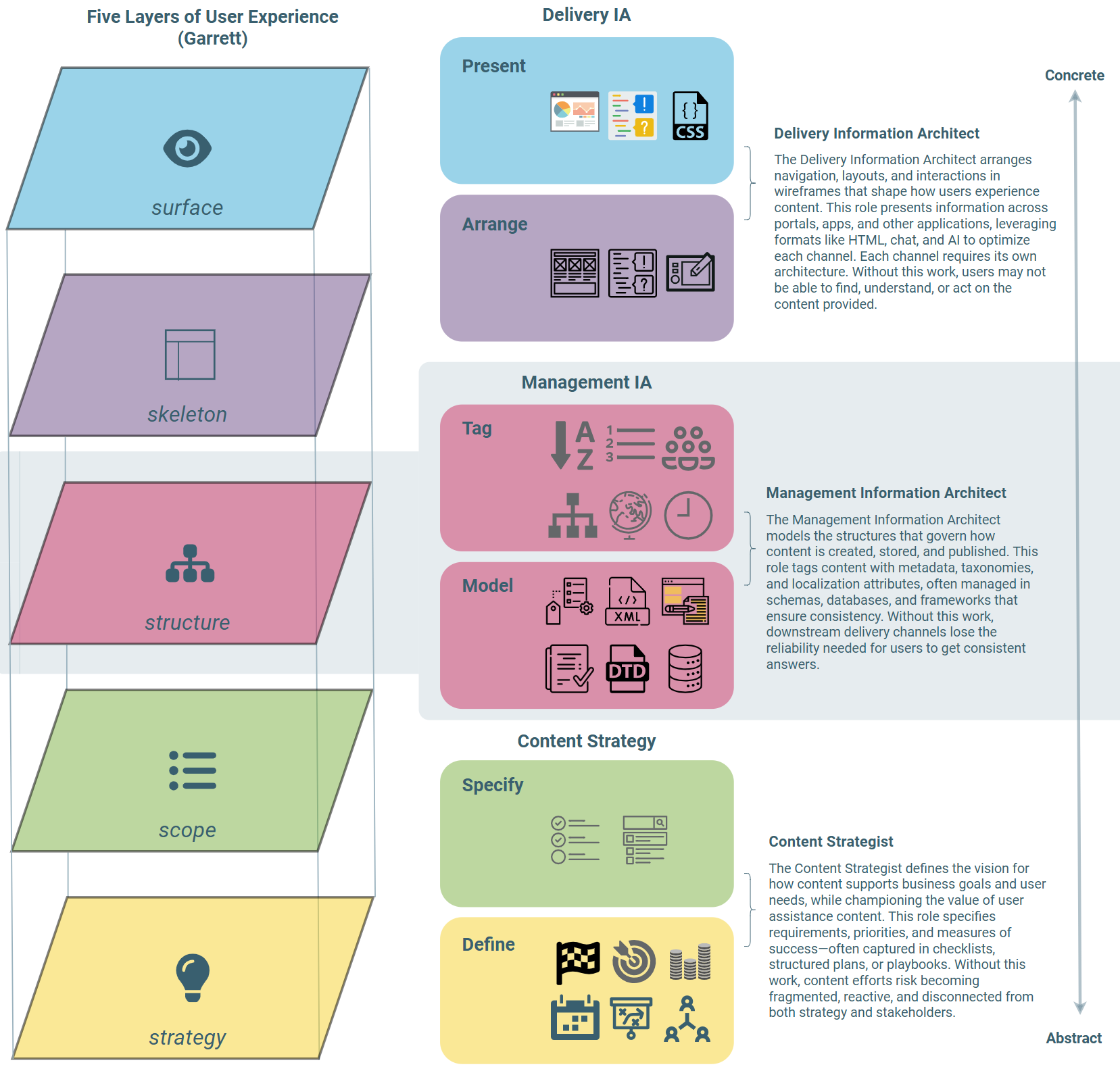
Delivery information architecture is the high-level, consumer-facing structure of a site, app, or channel: how content is arranged and presented so a reader can find and act on it. Distinct from micro IA (individual page structure) and management IA (the authoring-side content model and taxonomy that delivery IA depends on).
Multichannel vs. cross-channel: what “omnichannel” actually requires
Each delivery channel has its own unique requirements. Across some channels there may be overlap or similar requirements, but what works for a web portal will be different than a watch, a refrigerator, or a chatbot. This requires that each channel have its own delivery information architecture. And you almost certainly have multiple channels.
It is no longer uncommon to be using multiple devices simultaneously. You watch a Netflix movie using an app on your TV and simultaneously looking at your phone.
Resmini and Rosati make a related point in their work on pervasive information architecture: design each channel on its own and you get several disconnected experiences. Design the whole set of channels a reader actually uses, and you get an experience that feels cohesive and thought-through.
Consider a reader who consults one topic on your portal on their laptop, searches for the related procedure on a mobile device, and uses voice commands with your in-app chatbot. Three distinct experiences. It’s not so far fetched or uncommon.
Multichannel means the same content exists in multiple places. Cross-channel means it behaves as a coherent system across them. That is what “omnichannel” actually requires: not simultaneous presence everywhere, but a coherent system across every channel a reader touches. Resmini’s five rules address the second problem, which is the harder one: placemaking, consistency, resilience, reduction, and correlation. Not one of those rules is satisfied by redesigning the primary channel’s navigation. Each requires explicit decisions about how every channel expresses the same underlying structure. This is delivery information architecture.
Delivery IA vs. management IA: the dependency you can’t skip
Delivery information architecture is in service of your content strategy. And it can only deliver what’s available in the source at the management layer.
For example, you want faceted search on your site. These filters will help your users to find what they’re looking for. This requires metadata facets to exist in the content. Delivery IA tells management what must exist in the source before the delivery architecture can work.
A content strategist sets the vision for what each delivery channel needs to be. They define the user experience. A delivery information architect knows the tools and technology for that channel. It’s their responsibility to implement the content strategist’s vision.

To implement the vision requires having requirements. Sometimes the vision is too big or grandiose for the budget or timeframe. Oftentimes the vision may require custom code. It’s the delivery IA’s duty to inform the content strategist what is technically possible and what it will take to implement the desired user experience.
Not only does the delivery IA need clear requirements from the content strategist, but they also need the source content to have the necessary structures and metadata to support the user experience. The delivery IA cannot invent information that doesn’t exist at the source in the management information architecture.
The channel alignment matrix: an example
To illustrate what delivery information architecture looks like in practice, consider the following audit for a high-priority task: Troubleshooting a Hardware Error. This matrix maps specific channel requirements back to the source content model.
| Delivery Channel | User Task / Requirement | Required Source Attribute | Current Source Status (Audit) | Gap / Action Item |
|---|---|---|---|---|
| Web Portal | Filter by Product Version & Error Code. | prod_version (Metadata), error_id (Metadata) |
60% of legacy topics lack error_id. |
Blocked: Faceted search will fail. Must batch-tag legacy content. |
| Mobile App | Quick-scan “Resolution” steps on a small screen. | procedure_step (Componentized content) |
Content is currently in “Wall of Text” blobs. | Required: Refactor source into discrete <step> elements. |
| In-App Help | Surface “Related Specs” based on the current UI state. | ui_context_ID (Mapping attribute) |
No mapping exists between UI and docs. | Strategic Gap: Need Management IA to add context IDs to the model. |
| Chatbot/API | Return only the “Error Description” string. | short_description (Semantic element) |
Descriptions are inconsistent or missing. | Content Debt: Authors must rewrite short descriptions for 400 topics. |
What working delivery IA looks like
When delivery information architecture is grounded in a sound management framework:
A reader moving across portal, mobile, and in-app help encounters the same organizing logic on every surface.
Faceted search returns meaningful results because the metadata behind it was designed to support those facets.
In-app help surfaces the right content type because that type was modeled as a distinct, addressable component.
A team building a new channel knows what the source structure must provide before the first wireframe is drawn.
None of those outcomes are visible to the reader, but they’re noticed as “good user experience.” And that’s our goal.
How to start a delivery IA audit
Do not start with a wireframe. Instead, build the structural requirements first:
Inventory the channels and their unique tasks. For each surface (portal, mobile, API), define exactly what the user needs to do and which content types are required for that action.
Audit the source content for structural readiness. Pick your most critical user task and use the Channel Alignment Matrix shown above to check if the current source structure (metadata, types, components) can actually fulfill the channel’s design promise.
Map the gaps to your roadmap. Identify the missing metadata or un-modeled components. These gaps are your “technical debt” list for the Management IA and Content Strategist.
A content strategy baseline assessment maps both layers together. Get in touch to start that conversation.
References
- Jesse James Garrett. (2011). The Elements of User Experience (2nd ed.).
- Andrea Resmini, Luca Rosati. (2011). Pervasive Information Architecture.