 9 min read

The Strategic Value of Management Information Architecture
Management information architecture (also called back-end IA) models the structures that govern how content is created, stored, and published, and often depends on coordination with delivery IA and the content strategist.
Key Takeaways
- Management information architecture is the authoring-side structure, the content model, metadata schema, and controlled vocabulary, that governs how content is created and stored before delivery information architecture ever touches it.
- Search, personalization, localization, or AI retrieval cannot exceed what the structure plane provides.
The diagram below maps Garrett’s five planes of user experience (surface, skeleton, structure, scope, strategy) onto three roles that share the work: the content strategist specifies vision at the abstract end, the management information architect tags and models content at the structure plane, and the delivery information architect presents and arranges it at the concrete end, closest to the reader.
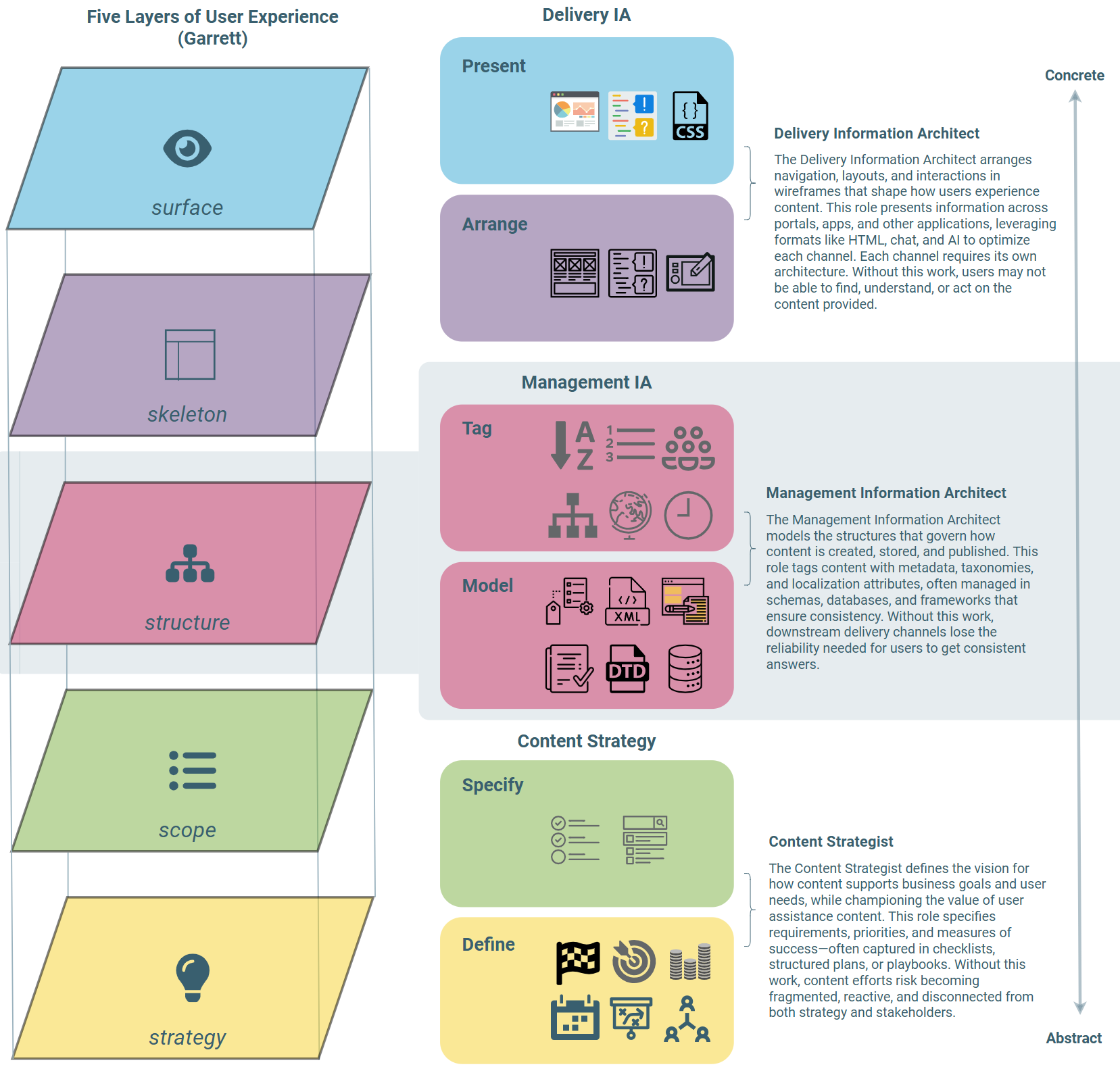
Management vs. delivery information architecture: the dependency you can’t skip
In Garrett’s five-plane model, management information architecture occupies the structure plane, between the scope decisions that content strategy makes and the skeleton and surface decisions that delivery information architecture translates into navigation and channel-specific experiences. Content strategy defines what should exist and why. Delivery information architecture designs how users find and consume it. Management information architecture sits between them, designing the structures that govern how content is created, described, and stored, so the delivery layer can express what the strategy specified.

That structure lives at the content source, whatever form the source takes: XML under version control, components in a CCMS, structured fields in a headless CMS. From that source, management information architecture produces a content model every delivery channel can draw from, while still accounting for what each channel actually needs out of it. It’s a superset of the needs of each unique delivery channel. The content model has to hold it all without forking into separate sources of truth, which is why a structured-content initiative starts here and not at the interface. The source is what every downstream channel is limited by, so it is the first thing that has to be right.
The three structural artifacts of management information architecture
A content model defines what types of content exist (concept, task, reference, troubleshooting), what fields each type requires, and how types relate. It makes content structurally predictable: the difference between unstructured text in containers and structured content that systems can reason about and route. The model also has to define the rules for reuse, beyond just types: which units are approved for reuse, what is allowed to vary when they’re reused (a product name swapped per audience, a warning included only for certain configurations), and who owns the canonical version when several teams all want to edit it.
A metadata schema specifies the attributes attached to each content unit: who it is for, what product version it applies to, what lifecycle stage it is in. That schema doesn’t have to sit at just one level, either. Metadata on a whole topic routes the piece as a unit. Metadata on a single component inside it makes that fragment individually reusable and retrievable on its own. Metadata on an individual element gives a system something to key off of below the level a human would normally bother tagging. A schema full of optional fields that authors fill in inconsistently is structurally identical to no schema at all, at any of those levels.
A controlled vocabulary governs the values that populate the schema (the taxonomy behind the metadata). Without it, a system searching for “installation requirements” misses content tagged as “setup prerequisites.” Controlled vocabulary is what makes metadata machine-resolvable rather than machine-readable.
These three artifacts are interdependent. A change in any component propagates through the others, which is why management information architecture requires ongoing content governance, not a one-time setup task.
The structure readiness matrix: a management information architecture example
To illustrate what management information architecture looks like in practice, consider the following audit across four downstream capabilities. This matrix maps each capability’s requirement back to the structural artifact it depends on.
| Downstream Capability | What It Needs | Required Structural Artifact | Typical Audit Finding | Gap / Action Item |
|---|---|---|---|---|
| Search | Match a user’s query terms to existing content regardless of phrasing. | Controlled vocabulary (preferred_term, synonym_ring) |
Vocabulary maintained ad hoc by whoever last edited the page. | Blocked: Relevance tuning becomes a recurring manual fix. Vocabulary must be governed centrally. |
| Personalization | Assemble content at a granularity fine enough for a rule engine to select. | Content model (content_type, component_boundary) |
Content authored as long-form documents, not addressable components. | Blocked: Segments can be identified but not served distinct content. Content must be remodeled into components. |
| Localization | Translate once per reusable component, not once per document. | Content model + reuse metadata (reuse_id) |
Content duplicated per document instead of referenced from one source. | Cost multiplier: Every duplicate is a new translation job. Must model for reuse before the next locale rollout. |
| AI Retrieval / RAG | Give a retrieval system clean chunk boundaries and current-state signals. | Content model (component_boundary) + metadata schema (lifecycle_state) |
Chunking follows arbitrary page breaks; no staleness flag exists. | Strategic gap: Retrieval can’t distinguish current from deprecated content. Content model and lifecycle metadata must both be added. |
Why weak content governance breaks search, personalization, localization, and AI
No downstream capability can exceed what management information architecture provides at the structure plane.
Search relies on consistent vocabulary to match what users ask to what content exists. Uncontrolled vocabulary makes relevance tuning a recurring manual fix, because the problem is upstream and no search platform can solve it.
Personalization requires content structured at a granularity fine enough to assemble selectively. Swisher and Preciado make the same point in The Personalization Paradox: personalizing at scale requires standardizing the content first. Tooling can identify audience segments in unmodeled content but can’t route them to components that were never designed to be addressed separately. The pipes work. The output doesn’t.
Localization compounds the cost. Rockley and Cooper’s unified content strategy model makes the mechanism explicit: a reusable component is translated once, at the source, and every reference inherits that translation automatically. Unreused content might start identical across five documents, but each copy drifts independently, and every edit triggers new translation and review, everywhere it appears. Translation memory can discount similar text; it can’t make five drifting copies behave like one. That difference is structural: it only exists if the content was modeled for reuse from the start.
AI retrieval, especially retrieval-augmented generation (RAG), exposes this. Chunking traces back to the content model. Topics authored as addressable units retrieve cleanly; undifferentiated documents don’t, whatever tags get added on top. The metadata layer doesn’t fix that. Type and lifecycle metadata tell the system what it pulled and whether it’s current. Get the content model wrong, and no amount of metadata downstream fixes it.
The business case for management information architecture
When management information architecture is funded as deliberately as the interfaces built on top of it:
Authors know what to write because the content model makes requirements explicit rather than optional.
Metadata is consistent because the schema is enforced: two authors describing the same feature use the same terms without a human reconciling them after the fact.
Components designed as reusable from the start mean localization happens once per component, and it never has to happen again per document.
Search and AI retrieval both have genuine signals to reason about, instead of guessing at what the content means.
None of those outcomes are visible to a reader either. But they show up as support deflection, localization cost, search precision, and AI accuracy: numbers a business case can already measure. The question is whether the investment that produces them appears in the same budget.
How to start a management information architecture audit
A sample job description for this role, written by Amber Swope, lays out what a management information architect is actually responsible for: developing the content model, defining taxonomy values with stakeholders, setting reuse rules and shared content, documenting guidance for authors, and coordinating with delivery counterparts on channel requirements and legacy conversion.
Audit the content model. Does a defined content model exist, specifying content types, required fields, and organization standards for each deliverable category, or is structure improvised per document?
Audit the vocabulary. Are taxonomy values and their relationships defined with stakeholders and enforced across the corpus, or does every author choose their own terms?
Audit reuse. Is there a real reuse strategy, covering approved shared content like boilerplate, warnings, and product names, plus the rules for how those units are allowed to vary, or is reuse ad hoc copy-paste?
Audit author guidance. Do authors have documented creation and reuse guidance, working samples, and the tooling they need to follow the model, or are they left to guess?
Audit delivery coordination. Is there a defined process for coordinating with delivery information architects on channel requirements and for converting legacy content into the model, or does every new channel and every migration start from scratch?
Those five checks map how much management information architecture actually exists, what is enforced versus assumed, and which of the duties in that job description have no one behind them. Get in touch when the gap is larger than the current conversation can hold.
References
- Amber Swope. (2024). Sample Job Description: Management Information Architect.
- Jesse James Garrett. (2011). The Elements of User Experience (2nd ed.).
- Ann Rockley, Charles Cooper. (2012). Managing Enterprise Content: A Unified Content Strategy (2nd ed.).
- Val Swisher, Regina Lynn Preciado. (2022). The Personalization Paradox.